Guide for community workers and groups
Our Guide below applies to simple neighbours’ street parties being held in 1 or 2 quiet streets or housing area, without wider publicity. Wider community public events need extra arrangements.

Street parties ARE community development
Street parties are a good way for residents to meet their neighbours which is the rock on which communities are built. Events can be held anytime, not only for national celebration days. Most people attend, mixing all ages and backgrounds, and the events are usually self-organised and funded.

You can build social capital and promote services to hard-to-reach households. Street parties are not complicated, but there is a knack to supporting residents to organise them.
We provide training and support services for working in communities on how to engage with residents through street parties. This would interest:
- community workers
- neighbourhood partnerships
- housing staff and tenants’ groups
- community safety specialists
- sports and arts development staff
- play and youth workers
- transport promotions
- other agency and council officers

Street parties build communities by:
- supporting social cohesion between age groups and ethnic and cultural backgrounds
- reducing fear of neighbours
- reducing fear of crime and promoting watchful neighbours
- getting to know young people
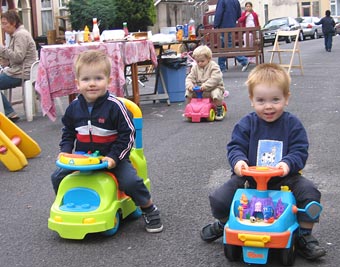
- giving children a chance to play together in their street for a day
- providing a chance to talk about local issues
We have proven evidence that street parties can help to build more cohesive and empowered active communities.

Why in the street?
There is something special about having an event right outside your house. The street is a shared public space, open to all. Normally the cars get in the way, but with the road closed to traffic, people can mingle easily and meet neighbours of all ages and backgrounds. A quiet empty road for the day is a rare and wonderful experience that changes people’s perception and sense of belonging. See more in our research
But street parties can also be held in areas outside housing blocks, parking areas, small green areas etc.
Because the events are right outside their door the turnout at street parties is never less than 50% and can be as high as 80%, unlike other community events. Street parties can lead to residents taking action on community safety, traffic and parking, or any other local issue.
We believe that street parties can become widespread and common, so developing neighbourliness across communities throughout the country. This is why we are involving and promoting street parties to all interested agencies.

How are street parties organised?
They are usually planned in the spring and held in the summer. September is common due to the 3-4 months lead time needed for a road closure notice. Residents have meetings, ideally in the street, involving all their neighbours and make all arrangements themselves.
Our key top tips, especially for first events are:
- Keep any music low, preferably live, acoustic and varied in styles – loud music puts some people off.
- There is no need to raise money in advance, until people have confidence in the idea.
- Involve all ages – tastes vary a lot.
- Keep it simple – don’t be too ambitious at first.
- There is no need to raise money in advance, until people have confidence in the idea. See more here.

Street parties can be organised at other times such as for
pancake day, mid-summer day, Halloween or pre-Christmas.
For more detail about activities etc. at street parties see our Guide for Residents.
The role of community workers and groups
Anyone working in a community can play a small but important role in facilitating residents to organise street parties.
The opportunity arises for this related work by organising surveys etc. during the party and/or by workers carrying out door to door surveys afterwards. However, in the first instance the party is best generated by residents and not seen to be imposed or run by community workers.
We have found that better-off communities have the confidence and skills to get on with it alone, with just a few tips from us. But confidence is low in many diverse communities and small barriers can put off even keen residents, particularly for their first event. Between them they usually have enough skills but need the encouragement to go for it.

Effects on a community
The powerful effect of street parties was shown one year when Street Alive facilitated 19 new street parties in one poorer community, Easton in Bristol. We believe it is the UK’s Street Party Capital, with over 35 events in recent years. Our local staff encouraged residents to go for it and gave some minimal support.
Our key role was to carry out post-event door step surveys of the houses. Half took part and the results showed that 97% wanted the street party again and that they had met an average of 8 new neighbours.
Most felt more positive about living in the street for reasons ranging from safety, friendliness, sense of belonging to less fear.
The overall result of saturating the area with street parties is that the whole community will repeat them and identify the area as neighbourly.
Southampton has 23 last year and Oxford are planning 75 this year with our support.

Social Cohesion
Street parties are a very powerful way of promoting genuine social cohesion. In the surveys above 89% thought that their street party ‘brought together neighbours with different backgrounds’ at least a ‘fair amount’. We have also carried out special research on how street parties are a unique way of promoting neighbourliness between all age groups. More detail on older people, neighbours and street parties here.

Creating projects to meet community needs
Facilitating street parties may be a useful project tool to support other aims of working in a community:
- Reducing fear for community safety
- Involving residents in neighbourhood renewal/management/regeneration
- Promoting social cohesion and reducing exclusion, as residents mix freely
- Providing an achievable activity for residents to develop personal skills and empowerment
- Integrating young people into the community
- Reducing conflict between young people of different backgrounds
- Bringing residents together to seek views about traffic or other community issues
Our approach
We suggest that each community worker initially supports 1-3 events in year 1. The next year you can build on this as part of a planned programme to saturate an area is important as one alone will have limited impact.
Our approach to street party facilitation involves keeping it very light-touch and giving only information and encouragement. This ensures that the events remain fully in the ownership of residents and they gain the skills and confidence to repeat them.

In particular we suggest that workers:
- Find a confident active person to spark things off with a couple of neighbours they know.
- Only give advice when asked for or when the residents may be making mistakes.
- Allow residents to make all arrangements themselves as they are likely to have the skills but just need encouragement and information.
- Advise raising money on the day, not before and ideally not provide funds directly so that they don’t rely on outside support.
We advise workers to not attend the party for very long on the day. The most useful role of support is in carrying out a survey of residents afterwards. This is very beneficial for and appreciated by residents who rarely get round to doing this.

Road Closures, Licences, Insurance etc.
In addition to our Guide for Residents, we provide a Guide for Councils. This includes advice on road closures, public liability insurance, licensing, noise and cleansing. The council traffic/highways team often play an important role in how they deal with interested residents. We encourage them to minimise the road closure procedure and to waive any fees. Ask us to help you with this and see our Guide on Road Closures.
In many cases street parties do not need insurance – see our Note on Insurance.
It is unlikely that a street party would require a license or Temporary Event Notice as any ‘performance’ would normally be ‘incidental’ and music ‘background’ for the day. Also, nothing is usually being sold.

Our services
Sounds all too easy? It is not difficult, but there is a knack to it. We provide training and consultancy to local authority or agency staff and community groups on how to support residents. This can be combined with other staff and residents. The training is based on years of experience of supporting residents, training staff and community workers in this activity.

